
East Hartford Arrest Records and Court Charges
East Hartford Police arrest records are police-side records. They can include the agency name, date range, run date, incident number, arrest date and time, court date and time, name, address, sex, race, age as of arrest date, statute citation, charge description, count, and the charge-and-description field from weekly adult arrest logs. Those fields describe an arrest event and alleged police charge at that point in time. They do not prove that a prosecutor filed the same charge, that a court found guilt, or that the case ended in conviction.
Court charge records are different. After an East Hartford arrest, the criminal or motor vehicle case usually routes through Connecticut Judicial Branch systems, often Manchester GA 12 for lower-level local matters or Hartford Judicial District for more serious cases. The prosecutor, called the State's Attorney in Connecticut, controls prosecution. The court record can show filed charges, amended charges, nolles, dismissals, pleas, convictions, sentencing, warrants, and probation terms. The full case file and final outcome belong with East Hartford criminal court records.
The East Hartford Police report FAQ is one official source for local arrest-report access.
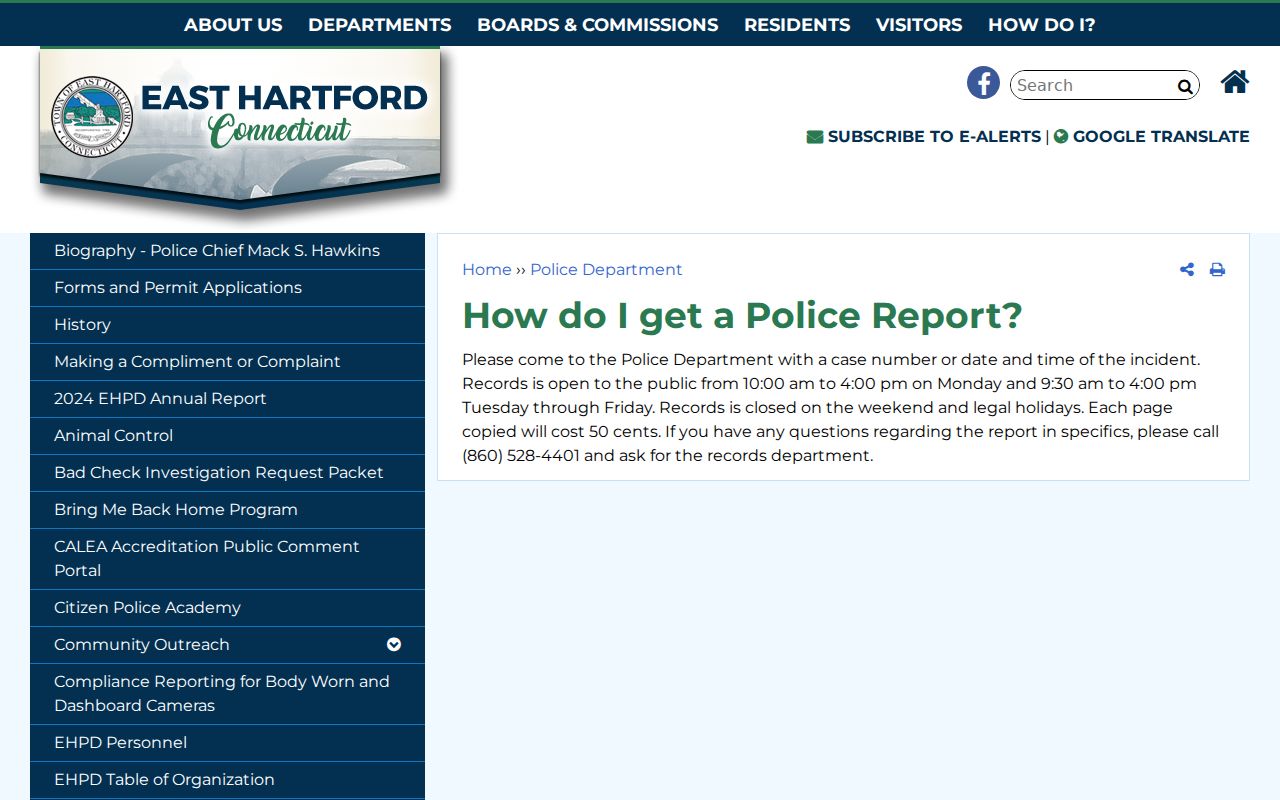
The source supports the police-record side of East Hartford arrest records, including the need for a case number or incident date and time.
Police Arrest Charges vs Court Charges
An East Hartford arrest log and a Judicial Branch case record can describe the same event but show different legal stages. Police may list one or more Connecticut statute citations at arrest. The State's Attorney may later file the same charge, reduce it, amend it, add a different count, decline to prosecute a count, or enter a nolle. A nolle is a prosecutor's decision not to pursue a charge, subject to Connecticut rules. A dismissal is a court ending a charge without conviction.
| Record Source | What It Usually Shows | What It Does Not Prove |
|---|---|---|
| East Hartford Police arrest record | Incident number, arrest date, booking-level charge description, statute citation, count, and court date. | That the court case ended in guilt or that the same charge remained filed. |
| Judicial Branch pending case | Public court charge data, defendant search fields, court location, category, and current case posture if public. | Complete police report facts or sealed evidence. |
| Judicial Branch conviction search | Conviction information for qualifying criminal and motor vehicle charges within public display limits. | Juvenile cases, youthful offender matters, infractions, or erased records. |
Connecticut public criminal lookup notices say conviction information is generally shown for no more than 10 years after sentencing unless a shorter Practice Book rule applies. Public criminal history can also change because of erasures, corrections, pardons, and other modifications.
Search East Hartford Arrest Records
Start with the record owner. East Hartford Police is the correct source for police reports, arrest logs, crash reports, and local complaint records. Connecticut Judicial Branch is the correct source for court charges after arrest, pending case status, daily dockets, convictions, warrants, and sentence review dockets. The East Hartford Town Clerk does not act as the Superior Court clerk for criminal cases.
- For police arrest records, contact East Hartford Police Records with the case number or incident date and time.
- For court charges after arrest, open the Judicial Branch criminal and motor vehicle lookup menu.
- Search pending cases by last name, optional first initial, birth year, court location, and case category.
- Check the daily docket if the issue is a court date, add-on docket, or same-day appearance.
- Check conviction search only when the question is whether a public conviction is displayed.
The East Hartford bad-check investigation packet is an example of a local police packet that can feed a criminal complaint process.
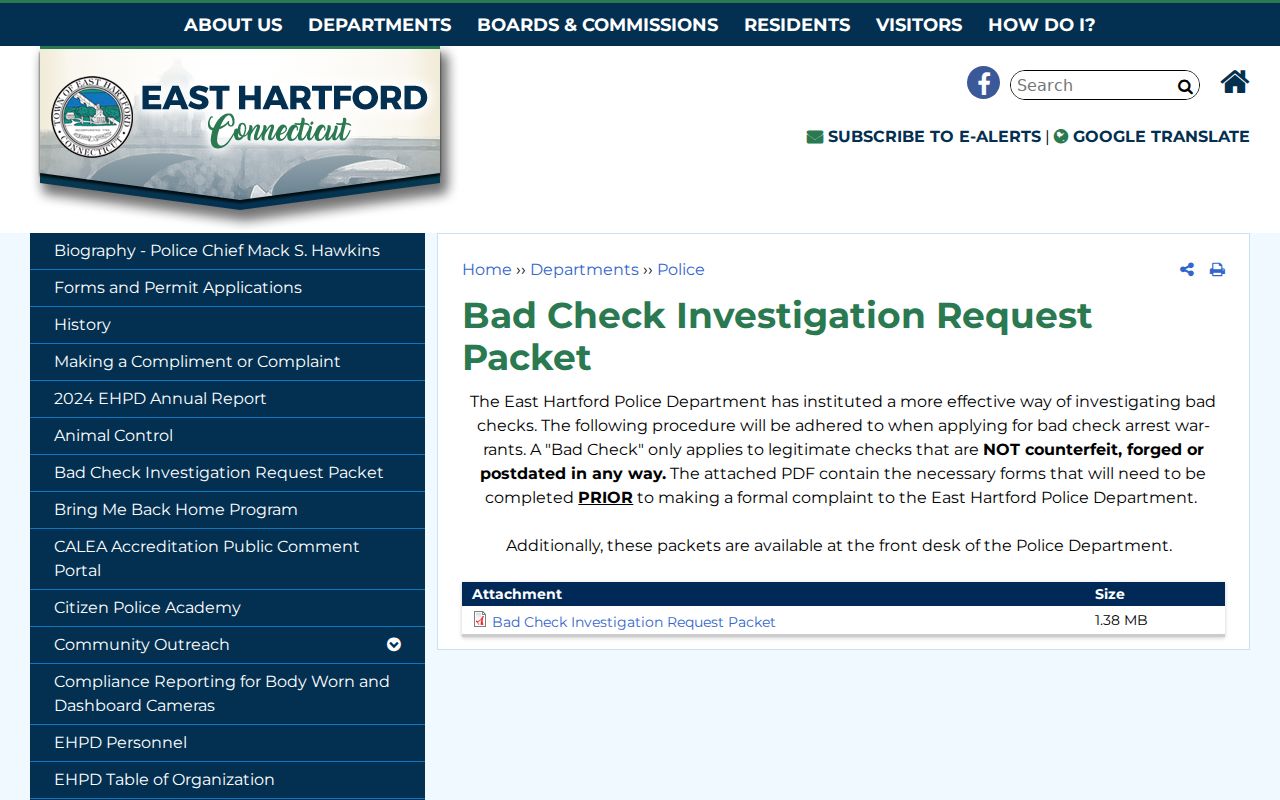
The packet shows why police-side documentation and later court charge records should be read as related but separate channels.
East Hartford Charging Documents
A charging document is the paper or electronic filing that starts or frames the charge in court. Connecticut local terminology and procedure may not use every generic label in every case, but the concepts help separate an allegation from the later disposition. The State's Attorney, not a county district attorney, prosecutes East Hartford criminal cases in the Hartford Judicial District system.
| Document Type | Who Uses It | How It Relates to East Hartford Charges |
|---|---|---|
| Complaint | Police or prosecution channel | Can describe the arrest event, allegation, statute, and facts used to begin a criminal process. |
| Information | Prosecutor | Can frame the formal charge list the State's Attorney chooses to pursue in court. |
| Indictment | Grand jury or serious-case process | Less common for routine local matters, but used as a formal accusation in certain serious cases. |
The Hartford Judicial District State's Attorney serves East Hartford and other towns in the district. The office at Hartford Superior Court handles more serious cases, mostly class A or class B felonies, while GA courts can handle many lower-level criminal and motor vehicle matters. That court split is why an East Hartford arrest can appear in Manchester GA 12 for one case and Hartford Judicial District for another.
East Hartford Charge Status
Charge status can change as the case moves from arrest to arraignment, pretrial hearings, plea, trial, disposition, and sentence. A charge is an alleged violation of a criminal or motor vehicle statute. A disposition is the outcome of the charge or case. The public record may show pending status, a new court event, an amended charge, a nolle, a dismissal, a conviction, or a sentence, depending on the court system and access rules.
| Status | Meaning in Plain English | Why It Matters |
|---|---|---|
| Pending | The charge has not reached a final public disposition. | A pending charge is not a conviction. |
| Amended or reduced | The filed charge changed from the earlier arrest or court entry. | The final charge list may differ from the police arrest log. |
| Nolle | The prosecutor chose not to pursue the charge, subject to Connecticut rules. | It can affect public display and later erasure analysis. |
| Dismissed | The court ended the charge without conviction. | Dismissals may become relevant to criminal-record erasure. |
| Convicted | There was a guilty plea or finding on that charge. | Conviction display is time-limited and affected by erasure or pardon changes. |
Note: One arrest can produce several counts, and each count can have a different status or final result.
East Hartford Charges vs Convictions
Charges and convictions should not be merged in background notes, tenant checks, employment reviews, or personal court research. A charge is an accusation. A conviction is a final result after a guilty plea, verdict, or other qualifying finding. Connecticut's public criminal lookup makes this distinction important because the pending search and conviction search answer different questions.
| Point of Comparison | Charge | Conviction |
|---|---|---|
| Legal stage | Alleged violation listed by police or filed in court. | Final guilt result by plea or finding. |
| Where to check | Police arrest log, pending criminal/motor vehicle search, daily docket. | Judicial Branch conviction search and court disposition records. |
| Can change | May be amended, reduced, nolled, or dismissed. | May later be affected by erasure, correction, pardon, or appeal. |
| Public meaning | Does not prove guilt. | Shows a public court outcome if still displayed. |
East Hartford Police Records Requests
East Hartford Police Records is the local channel for police reports and arrest-related records. The Police Department is at 31 School Street, East Hartford, CT 06108. Its Records Division is open to the public 10:00 a.m. to 4:00 p.m. on Monday and 9:30 a.m. to 4:00 p.m. Tuesday through Friday, closed weekends and legal holidays. The police FAQ says requesters should come with a case number or the date and time of the incident, and copies cost $0.50 per copied page.
The East Hartford Police complaint process also shows the department accepts certain public contacts in person, by telephone including TTY/TDD, mail, fax, email, anonymously, or through a third party.
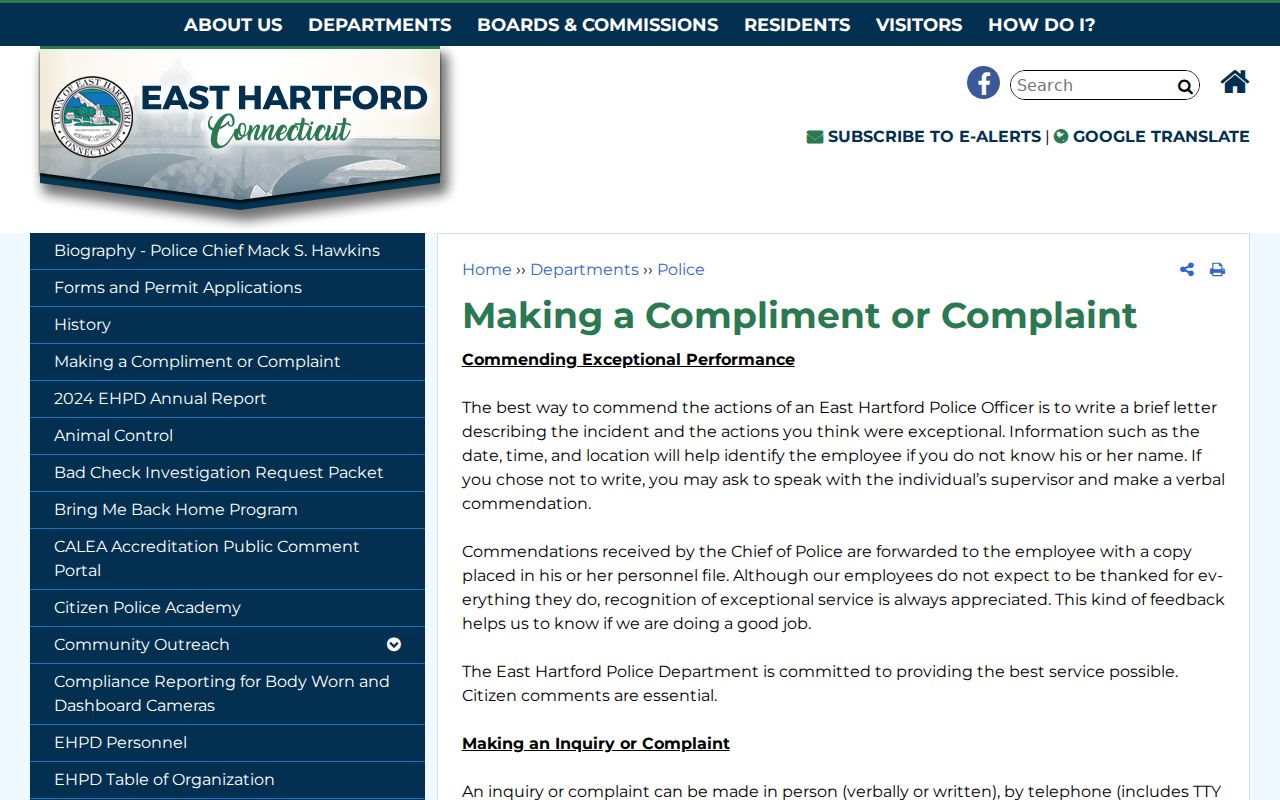
The complaint-process source is not a court charge database, but it documents the local police access channel for records and contacts.
Restricted East Hartford Charge Records
Some arrest and charge records are not public or are only partly public. Juvenile matter records are confidential except for statutory access categories. Youthful offender cases do not appear in the public criminal and motor vehicle conviction lookup. Erased criminal records are removed from public disclosure under Connecticut law after eligible dismissals, not-guilty findings, or other statutory events. Law-enforcement records may also be redacted or withheld because of pending investigations, privacy limits, or specific exemptions.
Connecticut FOIA applies to many public agency records, but it does not turn every police or court file into an open online record. Online Judicial Branch searches usually show index and status data first. Certified copies, complete documents, older paper files, restricted records, and redacted police reports may require the clerk, agency records request, identification, fee, court order, or proof of eligibility.
Important: Arrest data, charge data, and conviction data answer different questions and should be verified with the originating office.
East Hartford App Limits
The official My East Hartford app supports general questions and non-emergency service requests. It lets users pinpoint an issue location, attach photos, and receive status notifications. The research did not find an app-only inmate lookup, warrant lookup, or police records portal. It is not monitored 24 hours a day, and emergencies still go to 911.
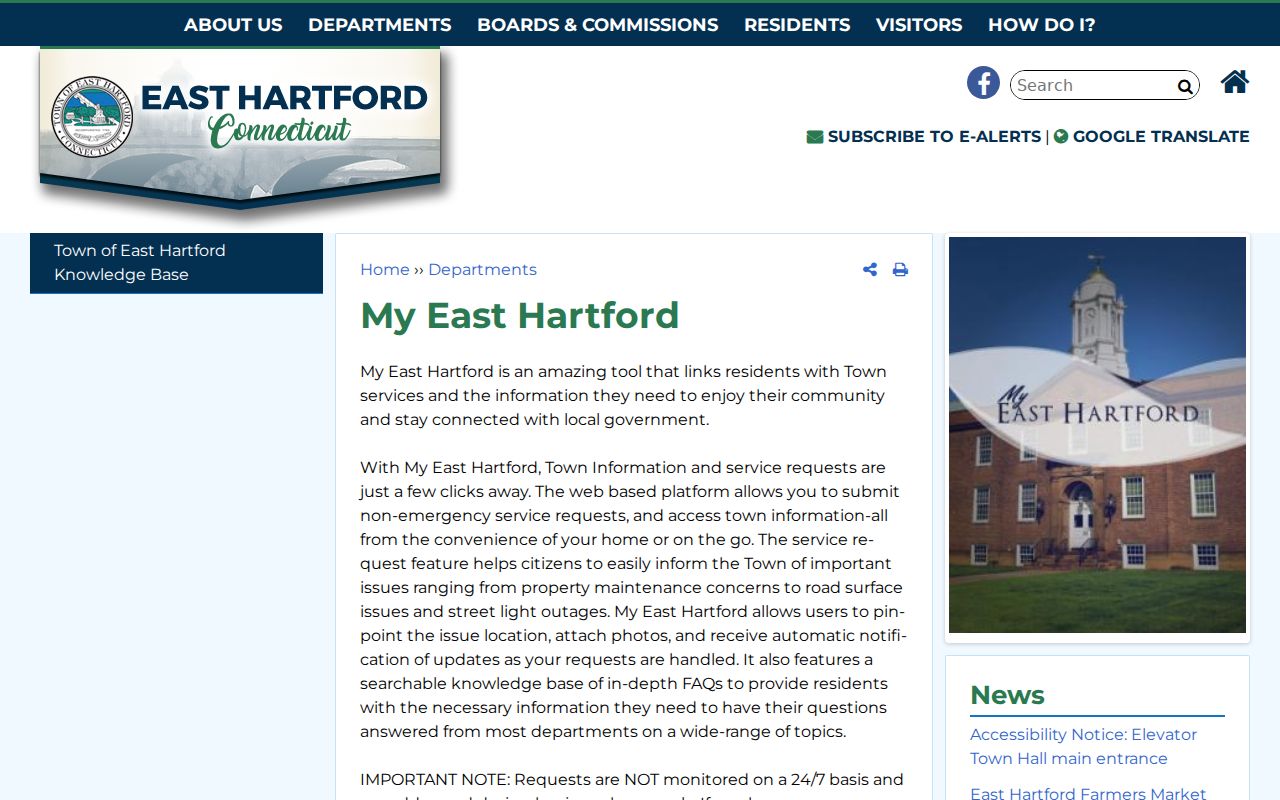
The app source matters because it confirms the town has a service app, but not a substitute for police arrest records or court charge lookups.